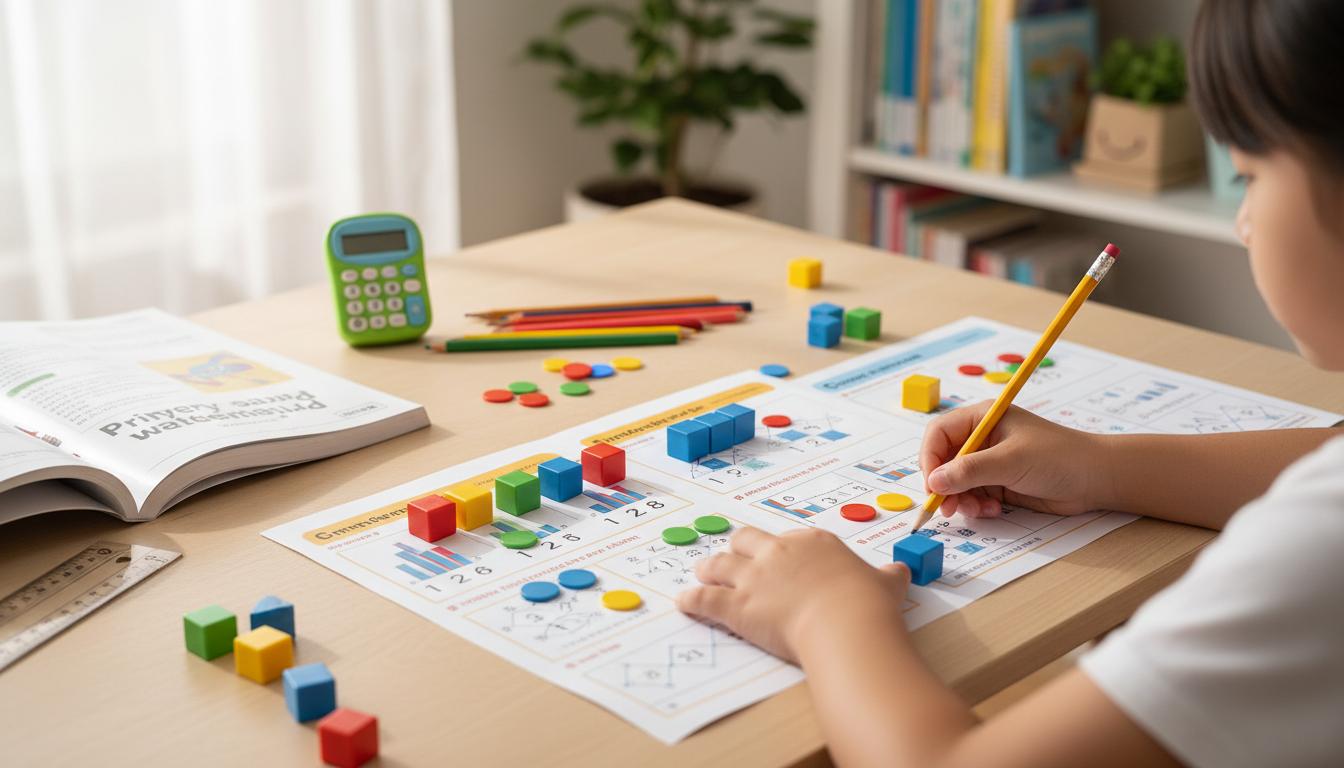
Math anxiety often takes root at home, not at school. Children pick up the adult relationship with numbers — the sighs, the avoidance, the “I was never a math person.” The most useful thing a parent can do is make math feel ordinary: present, talked about, and approached with curiosity rather than dread. Five practices build that habit, without a workbook in sight.
Why the home environment matters
Research from Sian Beilock and her colleagues has shown that parents’ own math anxiety can transmit to children through homework help and incidental cues, with measurable effects on children’s achievement (Maloney, Ramirez, Gunderson, Levine, and Beilock, 2015, Psychological Science). The implication is not to feign confidence — children read that immediately — but to model curiosity and persistence. A parent who says “I’m going to have to think about this one” and then does, in front of the child, teaches more than any worksheet will.
The five practices
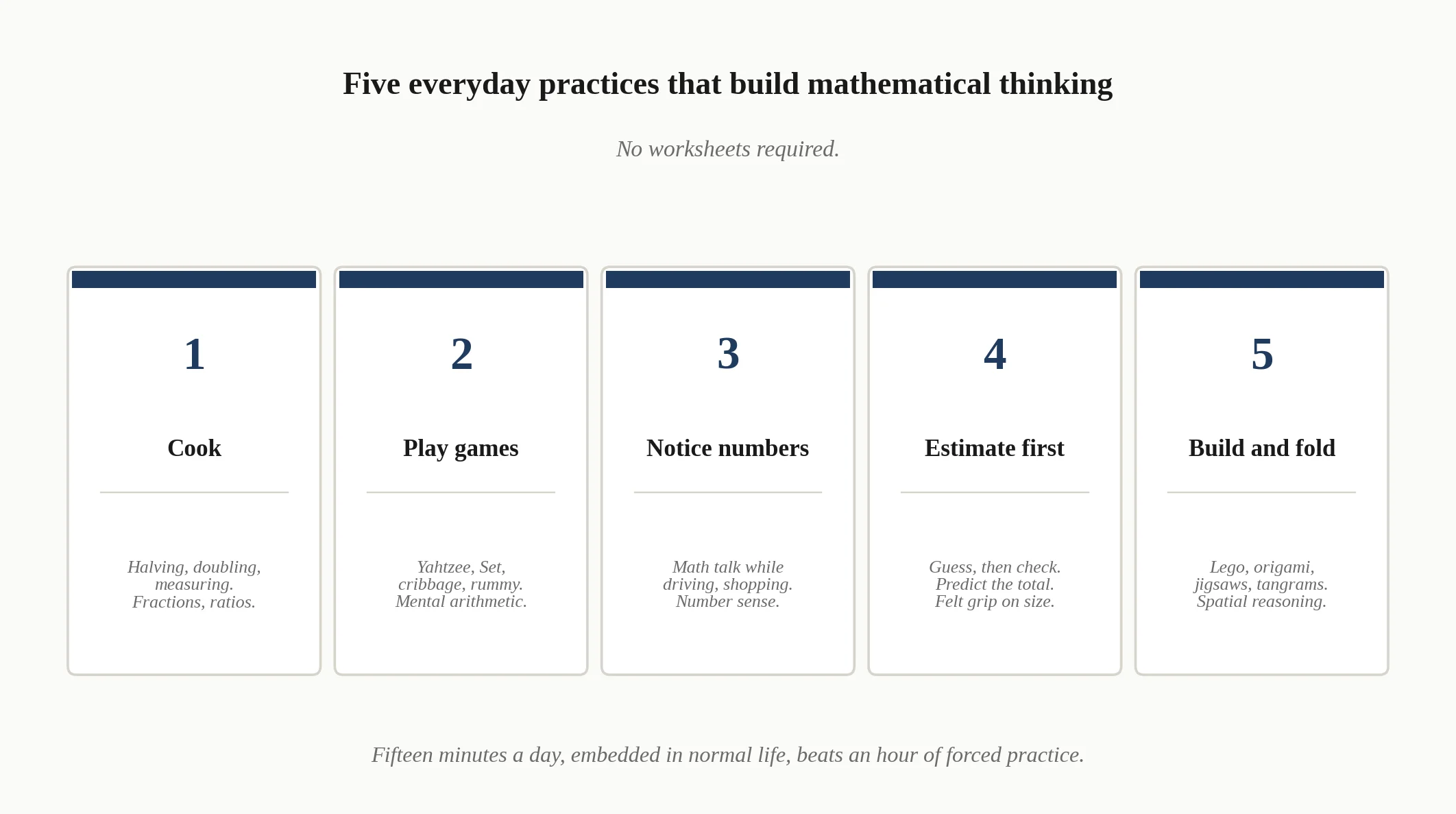
1. Cook together
Recipes are the lowest-friction math activity in any home. Halving a recipe is fractions. Doubling is multiplication. Adjusting for a different pan size is proportional reasoning. Asking a child to predict how many tablespoons are in a quarter cup, and then check, turns a measurement into a small experiment. None of this requires a worksheet, and the food at the end is its own reward.
2. Play games
Games carry math the way songs carry vocabulary. Yahtzee builds probability and quick addition. Monopoly teaches money sense and percentages. Sushi Go and Set sharpen pattern recognition. Cribbage and rummy build mental arithmetic without anyone calling it that. Ramani and Siegler (2008) found that simple linear number-line board games improved low-income preschoolers’ numerical knowledge in just four 15-minute sessions — a useful reminder that the dose does not need to be large to matter.
3. Notice numbers out loud
“Math talk” is a habit, not an activity. Notice the speed limit and how many minutes to the destination. Ask which line at the grocery store will move faster, and why. Estimate how many steps to the corner, and then count. Children begin to see numbers everywhere because the adults around them do. The reverse is also true — silence about numbers teaches that math lives only in school.
4. Estimate before counting
Estimation is the most undervalued skill in elementary math. Before counting jellybeans in a jar, guess. Before paying the check, predict the total. Estimation builds number sense — the felt grip on magnitude that distinguishes a child who knows 6 × 8 is around 50 from one who computes 48 with no idea whether it makes sense. Number sense is the foundation that the abstract phase of Singapore Math depends on.
5. Build, fold, and rearrange
Spatial reasoning predicts later math achievement (Mix and Cheng, 2012). Lego, origami, jigsaw puzzles, and tangrams all build it. So does asking a child to plan the most efficient way to pack a suitcase, or to draw the layout of their bedroom from above. Spatial thinking is mathematical thinking in a different language, and it is conspicuously absent from most homework.
A note on mindset
Carol Dweck’s research on growth mindset (Dweck, 2006) suggests that children who believe ability is built — through effort and good strategy — outperform children who believe ability is fixed. Two practical implications follow. Praise the work, not the talent: “you stuck with that hard problem” rather than “you’re so smart.” And model the same when the math is hard for you. Children take their cue from the room they are in.
What to avoid
- “I was never a math person.” Said out loud, this teaches a child it is acceptable not to be.
- Rescuing too early. Productive struggle is where learning happens; jumping in shortens it.
- Speed pressure. Accuracy and reasoning matter more than speed in the early years.
- Praise tied to fixed ability. Praise the effort and the strategy instead.
Sources
- Maloney, E. A., Ramirez, G., Gunderson, E. A., Levine, S. C., and Beilock, S. L. (2015). Intergenerational effects of parents’ math anxiety on children’s math achievement and anxiety. Psychological Science, 26(9).
- Ramani, G. B., and Siegler, R. S. (2008). Promoting broad and stable improvements in low-income children’s numerical knowledge through playing number board games. Child Development, 79(2).
- Mix, K. S., and Cheng, Y.-L. (2012). The relation between space and math: Developmental and educational implications. Advances in Child Development and Behavior, 42.
- Dweck, C. S. (2006). Mindset: The New Psychology of Success. Random House.