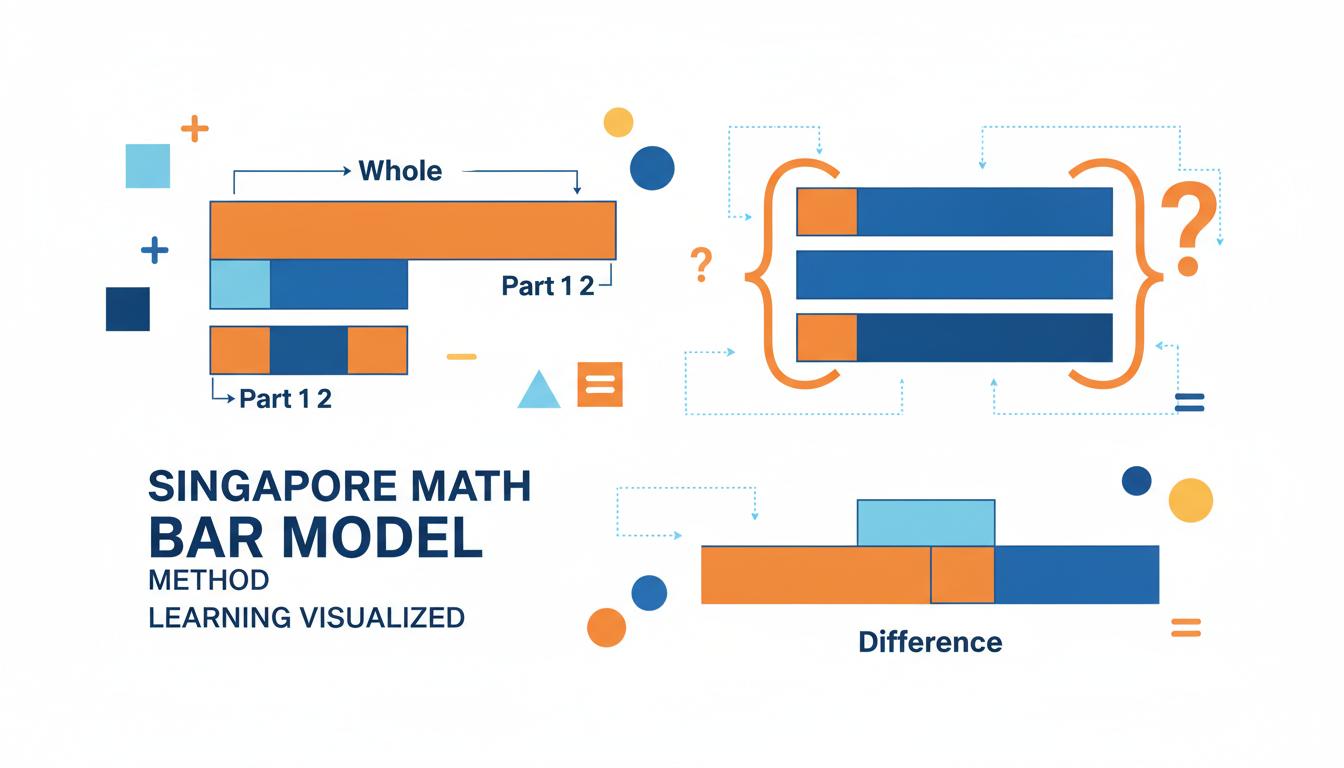
The bar model is a visual problem-solving tool at the heart of Singapore Math. Children draw rectangles to represent quantities and the relationships between them, turning the abstract words of a problem into a picture they can reason about. This pictorial bridge sits between concrete materials and abstract symbols — and it consistently helps children solve problems they would otherwise find overwhelming.
Why a picture changes the problem
A typical word problem asks a child to do two cognitive jobs at once: translate language into arithmetic, and then compute. Cognitive load theory, developed by the educational psychologist John Sweller in the 1980s, holds that when working memory is occupied by too many concurrent demands, learning suffers and errors multiply (Sweller, 1988). A picture offloads part of that work from working memory onto the page. The child is freed to think.
Allan Paivio’s dual coding theory (1971) adds a second reason. Information represented in both visual and verbal form is held more reliably, and recalled more accurately, than information held in one channel alone. The bar model is, in effect, a dual code: the words of the problem on one side, a picture of its structure on the other. Children working with bar models are not memorizing harder — they are remembering more, with less effort.
Where the bar model fits in Singapore Math
Singapore’s national mathematics curriculum is built on the Concrete-Pictorial-Abstract progression, an adaptation of Jerome Bruner’s enactive-iconic-symbolic framework from Toward a Theory of Instruction (Bruner, 1966). Children first manipulate physical objects — counters, blocks, cuisenaire rods. They then represent those objects pictorially. Only after the picture is secure do they move to the abstract numerical symbol.
The bar model is the pictorial bridge. It preserves the visual structure of the concrete experience while pointing toward the abstraction children will eventually need. By the time a child meets the algebraic equation, they have already met its structure twice.
A simple example
“Sarah has 12 apples. She gives 5 to her brother. How many does she have left?”
A young child draws a bar of 12, marks off 5, and sees the remainder. They are not solving an equation. They are seeing one.
A harder example
“A piece of ribbon is cut into two parts. One part is three times as long as the other. The whole ribbon is 48 cm. How long is the shorter part?”
For most adults, this triggers a brief algebraic translation: x + 3x = 48, so x = 12. For a ten-year-old who has not yet met algebra, the bar model makes the problem tractable. The child draws four equal units in a row — one for the shorter piece, three for the longer — labels the whole as 48, divides 48 by 4, and arrives at 12. The bar model has done the work that variables will eventually do.
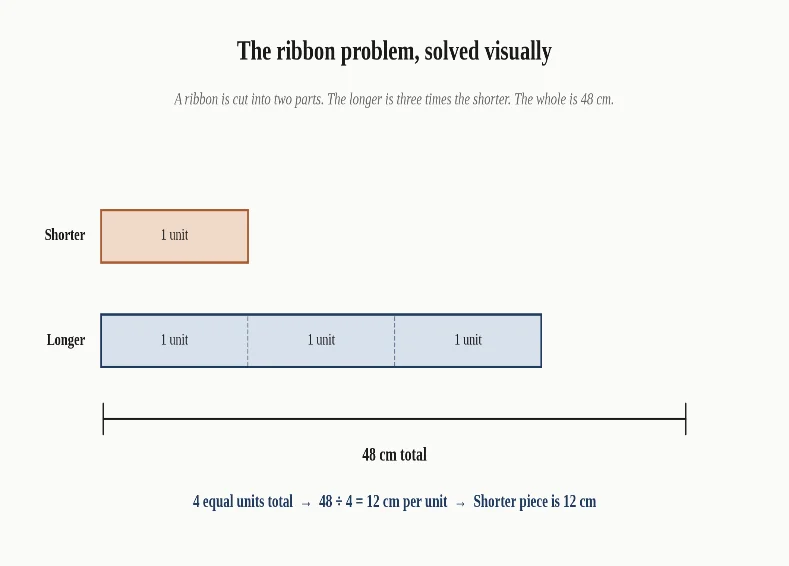
This is why mathematics educators sometimes describe the bar model as algebra without algebra. It builds the structural reasoning that later formal algebra will draw on.
What the research says
Singapore consistently ranks at or near the top in international mathematics assessments (TIMSS, multiple years; PISA, OECD). The curriculum that produces those outcomes has drawn growing interest from U.S. researchers. Pellegrini et al. (2025) examined the evidence base for Singapore-Math-aligned instruction and mastery-based pedagogy. At Orange County Classical Academy, a U.S. school using a Singapore-aligned curriculum, students reached 61% proficiency on California state assessments — compared with a 34% California state average (OCCA, 2023; California state assessment data). A single school is not a generalization, but it is a useful proof point.
What this looks like at home
For many parents, the first encounter with the bar model is unexpected. A child comes home from class and draws rectangles to solve a problem the parent would have solved with arithmetic. The instinct is to redirect: just subtract. The better move is to let the rectangles do their work.
The child is building a habit of thinking structurally before computing. That habit is what carries them through ratios, percentages, fractions, and the early years of algebra. Parents who recognize what they are seeing tend to relax into it quickly. The picture is not extra work. It is the work.
Sources
- Bruner, J. S. (1966). Toward a Theory of Instruction. Harvard University Press.
- Paivio, A. (1971). Imagery and Verbal Processes. Holt, Rinehart and Winston.
- Sweller, J. (1988). Cognitive load during problem solving: Effects on learning. Cognitive Science, 12(2).
- Pellegrini et al. (2025). “Effects of the Enactive, Iconic, Symbolic (EIS) Intervention on Student Math Skills in Primary School”, J. of Educational, Cultural and Psychological Studies.
- Orange County Classical Academy state assessment outcomes, 2023; California state assessment data.
- TIMSS, IEA International Association for the Evaluation of Educational Achievement.
- PISA, OECD.