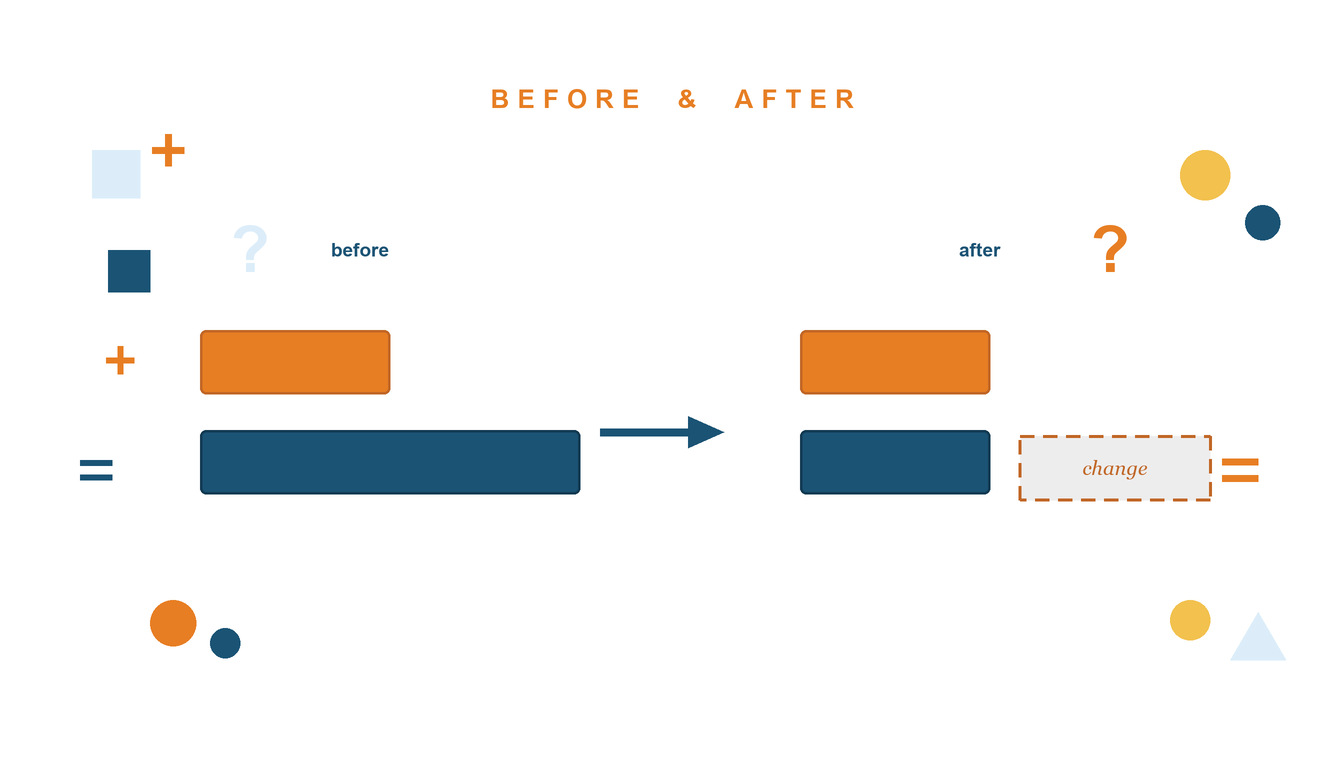
The before-and-after bar model is a way to solve word problems where something changes partway through — money is spent, items are given away, a quantity grows or shrinks. Instead of drawing one picture, the child draws the situation twice: once for “before” and once for “after.” Reading the gap between the two drawings turns a confusing two-step problem into something you can see. It is the bar model’s answer to the question that trips up most students: what do I do when the numbers move?
What is the before-and-after bar model?
The before-and-after bar model is a single problem drawn in two states. The “before” bars show the starting situation; the “after” bars show it once the change has happened. Because the two drawings sit side by side, the part that changed — and the part that stayed the same — are both visible at once. The child reasons from the picture instead of juggling steps in their head.
This matters because most word-problem errors are not arithmetic errors. They are tracking errors: the child loses hold of what changed while trying to compute. Drawing the change, rather than remembering it, frees up the thinking.
Why is “change” the hard part of a word problem?
A change problem asks a child to hold two situations in mind at the same time — the original and the result — and to reason about the relationship between them. That is a heavy load for working memory. A single bar model can capture a fixed situation; a changing situation needs a second picture so the “what happened next” has somewhere to live.
Once the second drawing exists, the difficulty mostly dissolves. The child is no longer remembering a sequence of events. They are looking at it.
How do young children first meet the idea?
Children rehearse the before-and-after move long before they meet a hard problem, using everyday quantities. Consider a simple one: you have 7 sweets and give 2 to a friend. The child draws a bar of seven, then draws it again with two crossed off. Two pictures, one small story of change.
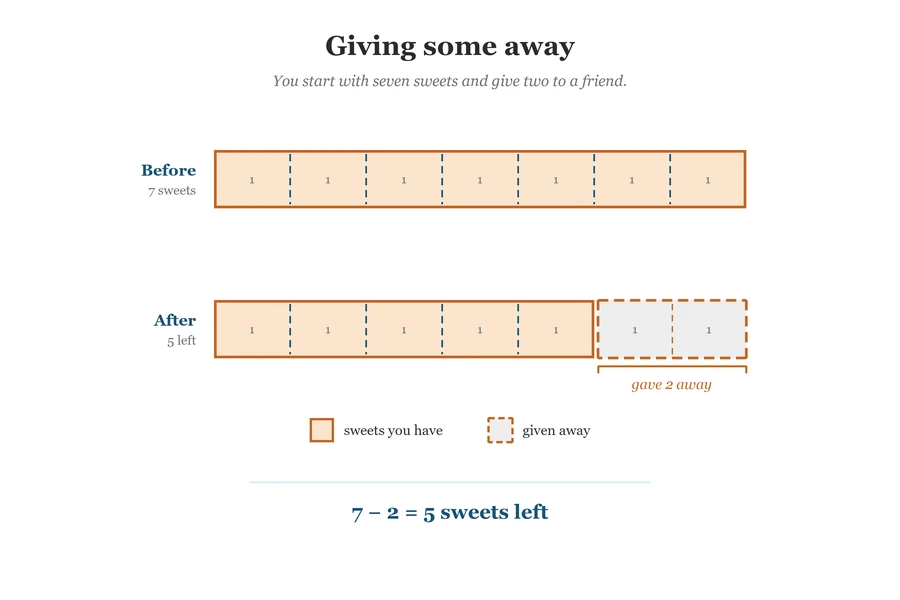
That little exercise plants the whole idea: a second drawing can capture what happened next. By the time the numbers get harder, the habit is already there.
A worked example: Tom and Jordan
Here is the kind of problem that makes many parents reach for scratch paper:
Tom had twice as much money as Jordan. After Tom spent $15, the two had equal amounts. How much did Tom start with?
Draw it twice.
- Before: Jordan is one bar. Tom is two of those same bars.
- After: Tom’s bar is shorter by $15 — and now the two bars match.
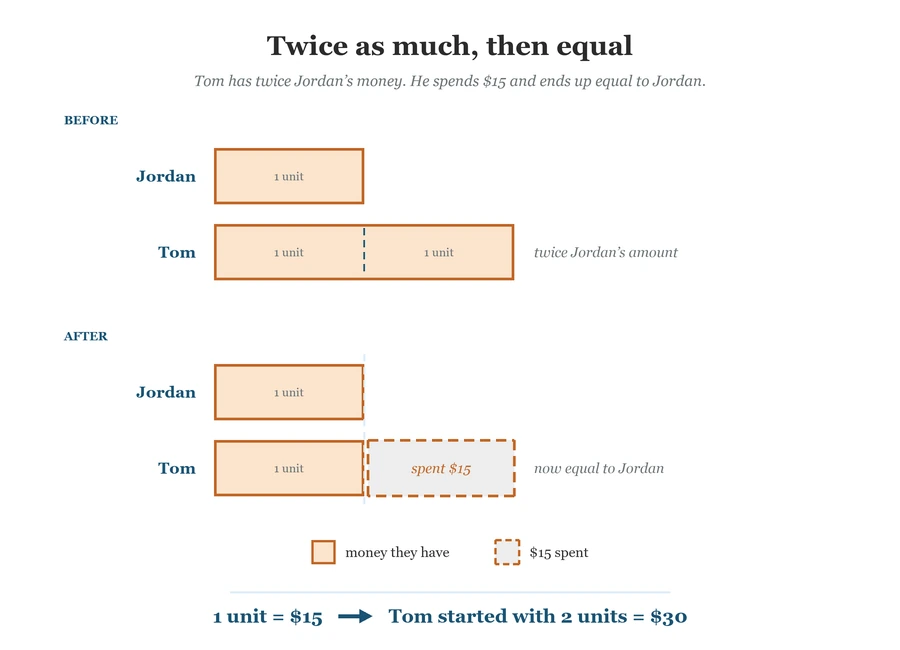
Now read the gap. If Tom and Jordan are equal after Tom loses $15, then that missing $15 must be exactly the one extra bar Tom had to begin with. So one bar is $15, and Tom started with two of them: $30. (Check: Tom’s $30 − $15 = $15, which equals Jordan’s amount.)
Notice there was no equation to set up and no variable to isolate. The two drawings did the reasoning. The arithmetic at the end — one subtraction, one doubling — was the easy part.
Why does drawing it twice transfer to harder math?
The before-and-after model teaches a habit that reaches well past primary school: freeze the starting state, represent the result, and reason about the difference. That is the same instinct a scientist uses to track a change over time, or an accountant uses to reconcile two columns. Here it is sketched in two stacked rectangles.
Children who can do this with bars are rehearsing the structure of multi-step algebra problems years before they meet the notation. The picture carries the logic; the symbols come later.
What does this look like at home?
When a child draws two diagrams to solve a problem you would have solved with arithmetic, the instinct is to redirect — just subtract. The better move is to let the second drawing do its work. The child is building a way of thinking about change that will hold up when the problems get genuinely hard. The extra picture is not extra work. It is the work.
Related reading
- Understanding the Singapore Math Bar Model Method — the pillar post on how bar models work and where they fit.
- What is Singapore Math? — the curriculum behind the method.
- The CPA approach — concrete, pictorial, abstract, and why the order matters.
Seriously Addictive Mathematics is coming to New York. Join the waitlist to follow the rest of the bar-models series.